

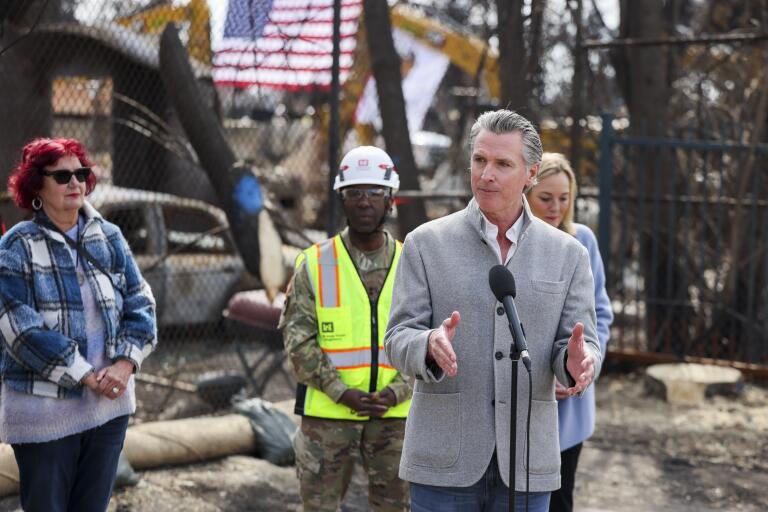
California Governor Gavin Newsom came to Altadena on Tuesday, September 15, to sign four new wildfire recovery laws addressing two problems that have continued long after the Eaton Fire: smoke contamination in homes that remained standing and financial pressure on homeowners trying to rebuild.
The package includes Assembly Bills 1642, 1795, 1842 and 1847. Together, the laws establish a new state framework for testing and addressing wildfire smoke contamination, expand insurance requirements for qualifying smoke damage claims and strengthen mortgage forbearance protections for disaster affected homeowners.
The legislation grew in part from problems reported by survivors of the January 2025 Eaton and Palisades fires.
New Standards for Wildfire Smoke Damage
AB 1642, authored by Assemblymember John Harabedian of Pasadena, creates the Wildfire Environmental Safety and Testing Act.
The law directs the California Department of Toxic Substances Control to develop science informed standards for testing, remediation and restoration involving lead and asbestos following wildfires. It also requires additional state guidance concerning other wildfire related contaminants.
The final law establishes interim standards for lead and asbestos while the state develops the broader regulatory framework. DTSC is required to adopt regulations addressing lead and asbestos testing, remediation and restoration by December 31, 2028. Additional guidance for other contaminants is due by December 31, 2029.
The California Air Resources Board must also develop guidance concerning indoor air contaminants following residential wildfire smoke damage by December 31, 2028.
The issue has become particularly important following the Eaton and Palisades fires because thousands of houses remained standing but were exposed to smoke, ash, soot and other combustion byproducts.
According to the California Department of Insurance, more than 13,000 insurance claims connected to the January 2025 fires involved standing homes with smoke damage.
At the Altadena bill signing, Harabedian described the goal of the legislation in direct terms.
“Science, not an insurance company’s opinions, will determine whether a home is safe,” Harabedian said.
AB 1795 Changes How Insurers Handle Smoke Damage
A companion measure, AB 1795 by Assemblymember Mike A. Gipson of Carson, creates the Smoke Damage Recovery Act.
The law establishes a rebuttable presumption for qualifying residential properties within a wildfire impact zone. If wildfire smoke, ash, soot, char or combustion byproducts are present in a surviving home after a wildfire, the law presumes that the resulting smoke damage came from that wildfire unless evidence establishes otherwise.
For covered smoke damage claims, the law also requires insurers to pay for sampling and testing necessary to restore a property to its preloss condition and clear it for human occupancy, subject to the terms and limits of the insurance policy.
Insurers also generally cannot terminate Additional Living Expense coverage for a covered smoke damage claim within the wildfire impact zone until the home has been restored to its preloss condition and cleared for occupancy, subject to applicable policy limits.
The new framework is scheduled to take effect in 2027, but there is an important distinction for Eaton Fire survivors with existing claims. Portions of AB 1795 expressly apply to residential property insurance claims occurring on or after the law’s operative date. Residents with unresolved claims from the January 2025 Eaton Fire should therefore not assume that every provision automatically applies retroactively to their existing claim.
Existing California insurance laws and claims handling requirements continue to apply in the meantime.
Mortgage Relief for Future Disasters
The other two laws address mortgage payments for homeowners whose properties become uninhabitable after disasters.
AB 1842, also authored by Harabedian, creates the California Mortgage Relief Act.
The law establishes a statewide mortgage forbearance framework for qualifying homeowners whose residential property becomes uninhabitable as a direct result of a federally declared disaster.
Eligible borrowers may receive an initial forbearance period of up to 180 days, with additional extensions available in 90 day increments, up to a maximum of 12 months, subject to the requirements and limitations contained in the law.
The legislation is intended to create a permanent system rather than requiring California to negotiate new mortgage relief arrangements after every major disaster.
Eaton and Palisades Fire Survivors Could Receive More Time
AB 1847 deals specifically with mortgage relief created after the 2025 Los Angeles fires.
The law extends the maximum mortgage forbearance period available to qualifying Eaton and Palisades fire survivors from 12 months to 24 months.
It also extends the latest possible deadline for requesting relief to January 7, 2029.
Borrowers seeking relief must meet several requirements, including affirming that they are experiencing financial hardship because of the wildfire disaster and that the property securing the mortgage is uninhabitable because of the disaster.
Forbearance is provided in increments rather than automatically granted for the entire 24 months.
AB 1847 also requires mortgage servicers to offer eligible borrowers the option of deferring repayment of forborne mortgage amounts until the end of the loan term unless the applicable investor contract or servicing guidelines prohibit that option.
Los Angeles County Supervisor Kathryn Barger and Los Angeles Mayor Karen Bass were official sponsors of the legislation.
Why the Laws Matter for Altadena
The legislation arrives roughly 20 months after the Eaton Fire began on January 7, 2025.
For Altadena residents whose homes survived the flames but were exposed to smoke and ash, the new laws attempt to address one of the most persistent questions of the recovery: how to determine whether a standing home has been properly tested, cleaned and made safe for occupancy.
For homeowners whose properties remain uninhabitable, the mortgage legislation provides qualifying borrowers with additional time before regular mortgage payments must resume.
The laws do not resolve every insurance or rebuilding dispute, and several parts of the smoke contamination framework still require state agencies to develop regulations and guidance.
Newsom signed the four bills in Altadena during a meeting with fire survivors, advocates, community leaders and the lawmakers who authored the legislation.
What Eaton Fire Survivors Should Watch Next
January 1, 2027 will be an important date as the newly enacted laws take effect, but the full regulatory framework for wildfire smoke contamination will take longer to develop.
DTSC must complete regulations governing lead and asbestos testing, remediation and restoration by December 31, 2028. Additional state guidance addressing other contaminants is scheduled to follow by December 31, 2029.
Residents with current Eaton Fire insurance claims should continue working through their existing claims and should not assume the new laws automatically change the terms of a claim filed after the January 2025 fire.
Homeowners experiencing insurance disputes can also seek assistance from the California Department of Insurance, which maintains resources for Eaton and Palisades fire survivors.
Everything Pasadena will continue following the implementation of the new laws and what they mean for Altadena, Pasadena and Eaton Fire survivors as the recovery continues.
Photo credit: Office of Governor Gavin Newsom